
Competitive Pokemon: meta-games, mind-games, social ontology, and reflexivity
Are video games worth serious thought? #3 Part 2

Competitive Pokemon is worth some serious thought. It warrants serious thought for one obvious reason: it takes a lot of thought to play it well. That’s a type of serious thought I don’t have: I don’t have that thought or skill to play I well. I’ve played it for so many years on Pokemon Showdown but my ELO is still pretty low.
But I’d argue it also warrants serious analytical thought as well, because, as one YouTuber has noted: competitive Pokemon is a very hard game to explain.
There is one aspect of Pokemon that I think makes competitive Pokemon hard to explain, and that makes Pokemon fascinating to me, and that is what I want to call its reflexivity.
How might I introduce Pokemon’s reflexivity?
Let’s say you’re just now getting into competitive Pokemon. You want to be the very best, that no one ever was. Then you would naturally want your team of to be the very best. So all you need to know are: which 6 mons are the very best?
Suppose you asked a competitive Pokemon player: what Pokemon are the best pokemon competitively? You would be met with a strange answer: They wouldn’t be able to answer the question without a qualifier. Without the qualifier the question makes no sense. That is because there is no such thing as a good Pokemon-in-itself. A Pokemon is only good relative to what is called a meta-game. There are Pokemon that have high Base Stat Totals, that intrinsically have high stats, that usually tend to be good in lots of meta-games. But there is no objective measure of “the best Pokemon”– because what “the best pokemon” is–depends on the Pokemon that others are playing at the moment– how good a Pokemon is depends at least partially upon whether or not people think that Pokemon is good.
Competitive pokemon is therefore a pretty good example one feature of social reality that is has been argued by social ontologists to distinguish social reality from natural reality: the reflexivity of social reality. That is because competitive Pokemon is a game whose existence depends not only upon the “rules” set by the developers of Pokemon, but it also depends also upon the way other people think about the game. The norms for playing Pokemon depends upon others’ players conceptions of the norms of competitive Pokemon.
In social ontology, reflexivity refers to the fact that change in our conceptions of ourselves changes ourselves. As philosopher of science Ian Hacking put it:
Responses of people to attempts to be understood or altered are different from the responses of things. This is at the core of one difference between the natural and human sciences, and it works at the level of kinds. There is a looping or feedback effect involving the introduction of classifications of people. New sorting and theorizing induces changes in self-conception and in behaviour of the people classified. These changes demand revisions of he classification and theories, the causal connections, and the expectations. Kinds are modified, revised classifications are formed, and the classified change again, loop upon loop. 1
The reflexive aspect of Pokemon, I argue, is why “meta-game” is a term used often in competitive Pokemon. As the meta changes, the game changes.
—
We can distinguish three different times when Pokemon becomes reflexive, becomes “meta”
Meta-games as community rulesets
Meta-games as popular strategies and popular teams (and its cascading effect on the way others play the game)
Moments where the game becomes meta–unpredictable mind games

Not a real university.

Meta-games as Community rulesets
The most straightforward meaning of “meta” or “meta-game” in Pokemon is the ruleset. In Pokemon you can play Doubles, in which each team uses two pokemon at once, or you can play Singles, where each team uses one Pokemon. There are a variety of Doubles and Singles meta-games, but the most popular are called OU, UU, and VGC.
On Pokemon Showdown (which is ran by Smogon University the informal authority in the Pokemon community on competitive Pokemon– not affiliated with The Pokemon Company) you can see a list of meta-games that you can choose to play. This might become outdated fairly soon– as The Pokemon Company just came out with an app, Pokemon Champions that might be a Showdown killer – I am writing this in 2026. The official meta-game that The Pokemon Company supports is a doubles ruleset called VGC–video game Championship, but I think it is easier to explain what meta-games are if we go with Smogon’s singles meta-game. OU– which is the standard meta-game for singles, is called Over Used, as it is has the Pokemon that are, well, used too much, that’s why it’s called over used. More precisely, “A Pokémon is truly OU if a typical competitive player is more than 50% likely to encounter that Pokémon at least once in a given day of playing (15 battles).” Then there is UU, which stands for under used, and includes only those Pokémon that make up at least ~4.52% of total weighted usage. Then there are tiers below UU, such as RU (rarely used), NU (Never Used, and PU. Smogon measures how often people use each particular Pokemon and it fits them into the corresponding tier. The reason why they do this is because the metagame (in my view) constitutively depends upon what ‘mons most people are using. Your team is no good if you don’t have a regular answer to those `mons that you tend to go against most often.
Smogon tends to have rules that make playing competitive a bit less luck based and a bit more difficult to cheese. For example, they tend to ban abilities make for strategies that are based purely on luck, such as the ability Moody, which raises two of the Pokemon’s random stats and lowers one of the stats every turn. They also ban moves that automatically knock out an opponents Pokemon in one turn (which are allegedly balanced because they have an extremely low accuracy, and low chance of hitting) such as Sheer Cold.
Most people who play Pokemon play the unofficial, Smogon rulesets, rather than the official ones–as they prefer these rules that make the game less luck based.
Paraphrasing philosophers of language and social ontologists: we are norm-instituting creatures. Pokemon is a norm instituting practice: play of the game institutes norms about how it is played, which in turn influence how it is played, which in turn influence the norms about how it is played. Communities, such as Smogon, create norms of Pokemon play outside of institutional sanction. These norms, despite their lack of institutional sanction, have normative force: a player will expect that if you are playing singles you mean a Smogon ruleset.

Meta-games as popular strategies and teams
The norms of pokemon play are more flexible than the rules of rock-paper-scissors or chess. This is because of the element of teambuilding in Pokemon: you choose which options (moves and abilities) you have open to you beforehand. Pokemon is like chess but if you brought your own unique chess pieces to the board, or, you brought your own “moves” to rock-paper-scissors.
You might have known a kid on the playground who insisted on playing a rock paper scissors variant with dynamite that beats everything) but as anyone who has played with a two year old knows, playing a game of anything goes is not fun. Competitive Pokemon is not “anything goes,” as there are still some basic constraints: your team must be 6 mons that can be obtained in the actual game. And so there is another game within the game: building your team and developing your general strategy. This is what Pokemon players usually mean when they refer to the ‘meta’ –not to the ruleset, but to the dominant strategies and teams within the particular ruleset.
Popular teams have a cascading effect on the rest of the game. Whatever teams are most popular, those are the teams that you will face the most, and those are the teams you need to have an answer to. And so the meta becomes the most popular teams and whatever answers the most popular teams.
So whatever the Pokemon community believes is good, in some sense, becomes good.
What the correct move or Pokemon to use on your team therefore depends upon the regularity of certain dominant strategies. To play, you need to predict your opponent’s general strategy: what mons they will have and which four moves they will give their mons.
This is where the utility of websites like Pikalytics lies. https://www.pikalytics.com/pokedex/gen9ou
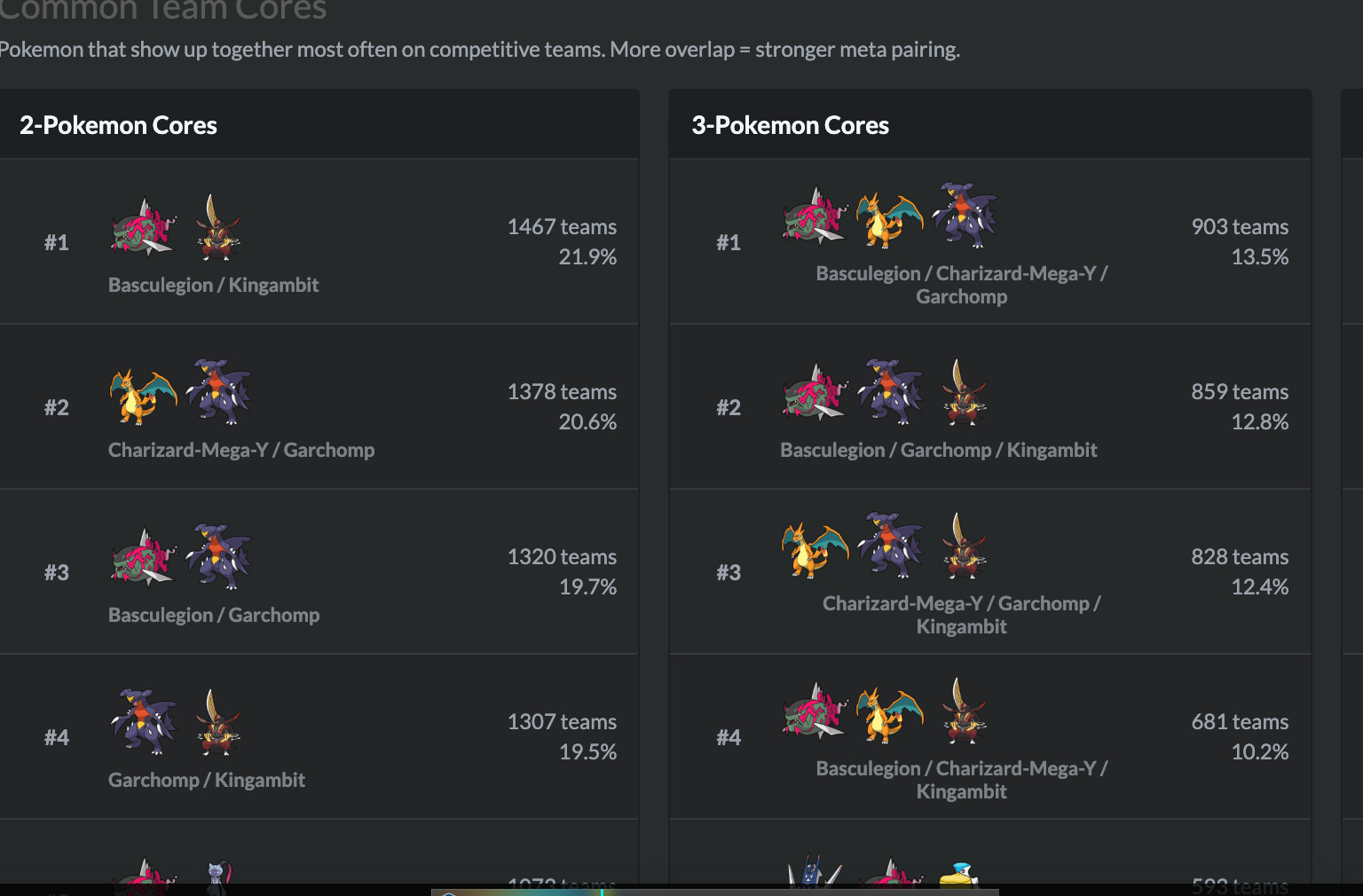
These websites help you know what pokemon you are likely to go against and therefore adjust your team to counter those.
Pikalytics is not something that stands “above” competitive Pokemon, somehow detatchedly and scientifically measuring competitive Pokemon without participating it. Like real world social scientists, Pikalytics’ measurements of society (in this case, Pokemon) affects the game– changing the meta by enabling thousands of people to know what mons they should use, and therefore, influencing what mons are most popular. Pikalytics participates in the very thing it measures– just as social scientists are themselves social actors– just as an economist’s prediction about the economy might influence economic actors.
Some philosophers– such as Alasdair Macintyre have used this reflexivity point to argue that “social science” is a misnomer– as social scientists cannot make predictions in the same way that natural scientists do. And as it turns out, Pokemon is structurally similar to one of their examples.
Meta gaming as unpredictable mind games
In a lecture published on Youtube called the “Unpredictability of Human behavior,” Alaisair Macintyre uses game-theoretical examples of reflexivity to illustrate that, unlike what some social scientists or economic determinists might tell you, there is an fundamental element of unpredictability within human behavior:
This third sort of unpredictability is illuminatingly stated in game theoretic terms. Let us suppose you are in a newly liberated Third World State. There are a whole lot of people jockeying for positions of power. There are the politicians of the various parties: the government to whom the ex-colonial power handed over political power, and the oppositionist parties of various brands. The trade union leaders. There are the military. The Marxist-Leninist revolutionary party of east wherever-it-is. All these people are sitting around watching the others. They have all had read a stock of books which includes Lenin on State and Revolution, Lipset’s Political man, all this sort of stuff.
Every one of them wishes to know what the others are going to do. But in predicting what the others are going to do do they will have face the fact that a major component in the decision that the others make as to what they’re going to do is the decision of the others, ie, the prediction of the others, as to what they are going to do. So they are essentially engaged in predicting what the others will predict about what they will predict about what the others will predict about what the others will predict…etc. That is to say that they are involved in a prediction which does not involve an infinite regress but an indefinite one.
The important thing to see here is that is that in this particular game theoretic situation, there is no uniquely rational solution for any of their players and all of the players know there is no uniquely rational solution open for any of the players. And in this situation, the action of each player become unpredictable to others. This apparent in the politics of Uganda, where the commander of chief of the armed forces and the President were each planning to arrest each other. And in the end, the commander in chief arrested the president on a Friday, the president having planed to arrest him on a Monday. Originally the commander in chief was going to arrest the president on a Tuesday, but then he put the date forward to the Friday and so won. Each of them were putting the dates forward for some time according to just this pattern. And in this kind of game, there is no way to predict the outcomes for the player, and it follows there is no way to predict the outcome for the observers, for there is no information for the observer to have which will put him in a better position to make a bet than the predictor. That is to say, third world governments shouldn’t add to their burdens by employing political experts, as they will not score better at these games.2
These sorts of indefinite predictions occur a lot in Pokemon. When playing Pokemon, you want to predict what your opponent will do in the next turn in order to determine what you will do on your turn. This means you need to know your opponents strategy– But one consideration that is factored into your opponents strategy is their prediction of your strategy: thus you want to predict your opponent’s prediction of you. And so you want to predict how much they will predict that they will predict….. indefintely. ). How much you predict is itself a move in a game, is itself a strategy. Predicting too much, playing too many mind games, might hurt you– predicting too little will definitely hurt you as well.
The main way this unpredictable indefinite regress occurs in the game is best analogized to rock-paper-scissors.
In that game you can predict that if you choose rock, your opponent, if they are predicting you well, will play paper. But if you can know that, then you know you should do scissors. But if they know that, then they should choose rock. But if you know know that, you should do paper….. and so on.
In Pokemon, you have these rock--paper-scissors matchups often. This is because of the type chart. The simplest model of this behavior is if both teams have a fire-water-grass core. In this simplified model, a Fire Pokemon always checks grass, a grass Pokemon always checks a water Pokemon, and a water Pokemon always checks a grass Pokemon. It has the same structure as rock-paper-scissors.
And so you from here you can have a mind game: will I stay with my water Pokemon, or will I switch to fire, predicting that you will switch to grass, or will I predict that you will predict I switch to fire and instead switch to grass, or will I predict that you will predict that I will predict that I will switch to grass, and stay with water. This is what I mean by the “amount” of times you predict matters– too many predictions and you overthink the game and your opponent, but too little predictions and you are playing in a very predictable way. Mind games involve “baiting” your opponent into making a bad play– baiting them into overthinking the game (or into underthinking it).
When you find yourself in a mind game, there is no way to go “above and beyond” the mind game to predict, in an inductive, algorithmic, way what the opponent and your optimal move will be, without determining what you will do beforehand. All of the social science in the world will not get you a prediction. If this argument is sound, Macintyre is saying that Pokemon play, at least when the turn becomes a mind-game, is inherently unpredictable.
How to be the very best
If what I am saying is right, then, then there is no science of Pokemon. There is no game theoretic way to win at Pokemon. Pokemon, like social reality on the view of those like Charles Taylor or Alasdair Macintyre, is not something from which one can make law-like generalizations. This is because any conceptual innovation in measuring and predicting Pokemon play is also an innovation in playing Pokemon– therefore changing the game that they are measuring and predicting. We are caught in a circle: new strategies change how people think about old strategies and therefore change the game. The only way to play Pokemon is to admit the players live in this circle– what these philosophers call the hermeneutic circle. The only way to play pokemon is by understanding the opponent not by trying to go “outside the game” but by going “inside the game”– so to speak– by playing the game a lot– inhabiting their mind, trying to get into their head. Because the thoughts of the opponent help create what it is that the opponent is playing. Pokemon is so reflexive that playing it well can only be an art, not a science.
What’s next
With this piece out, my writing on video games is done for the time being. I think what I will write next will be a couple of short pieces on AI, demystifying and clarifying some things about my take on AI. After that, I may also go back and continue writing more posts on my intellectual-theological journey, or I may return to writing about video games, depending on my mood.
Ian Hacking, 1995, The Looping Effect of Human Kinds. See also chapter 9, ‘Reflexivity” in Francesco Guala, “Understanding Instituions: The Science and Philosophy of Living Together”, 2016.
“That is because there is no such thing as a good Pokemon-in-itself.”
The Landorus-Therian in the corner: am I a joke to you?